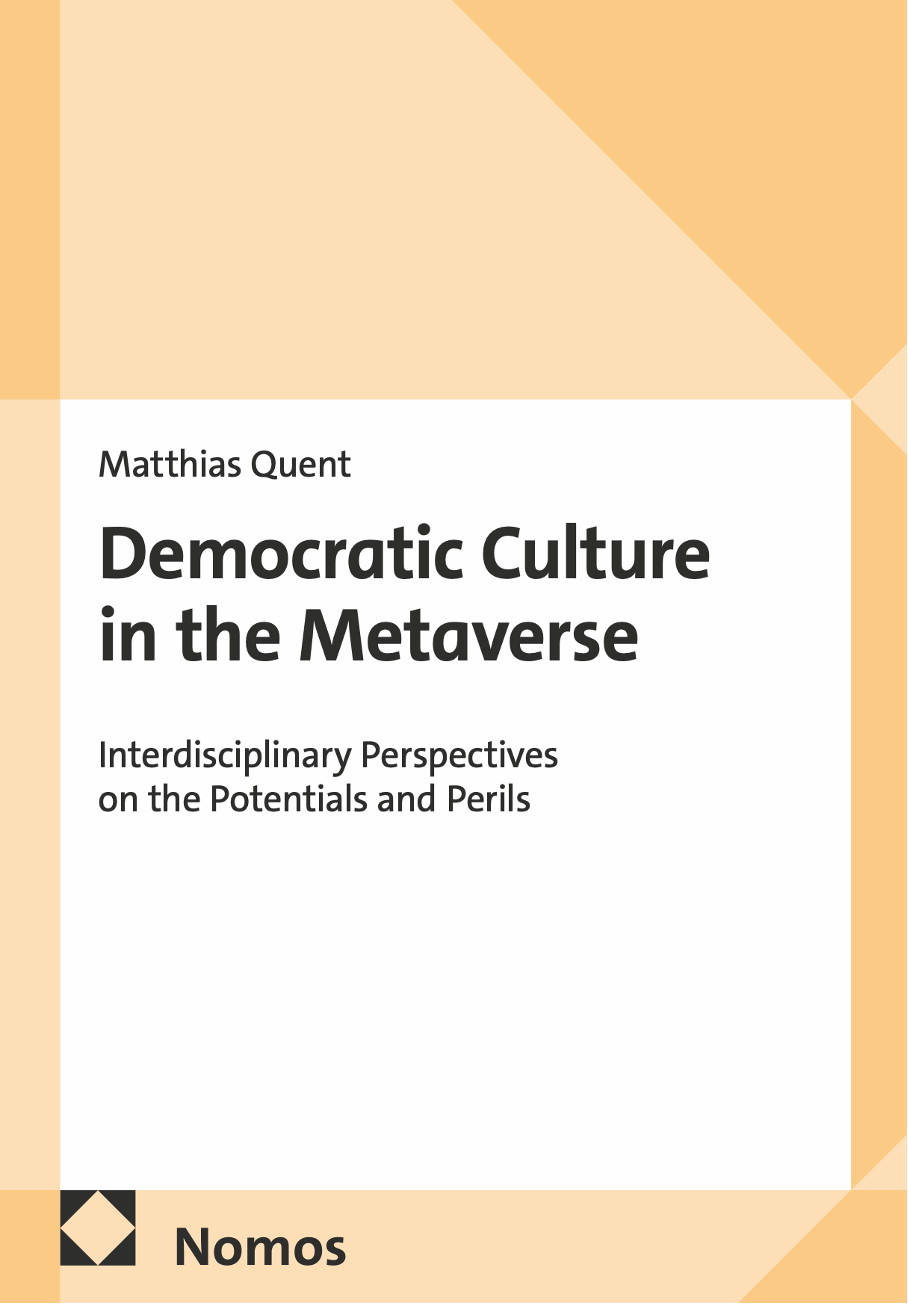
Cover of the book "Democratic Culture in the Metaverse"

Democratic Culture in the Metaverse. Interdisciplinary Perspectives on the Potentials and Perils

Edited by Matthias Quent (Nomos, 2025, Open Access)

This edited volume addresses a question that has so far hardly been examined in a systematic way: How can democratic culture be preserved, strengthened and reimagined in immersive digital spaces – in the metaverse, in VR and in social VR?

From an interdisciplinary perspective, authors from sociology, law, media and cultural studies, computer science, design and educational practice explore the opportunities and risks of immersive technologies for democracy, human rights and civil society. The volume emerged from the project Immersive Democracy within the European Metaverse Research Network.

The contributions deal with, among other things:

  • theoretical foundations of “immersive democracy” and democratic culture in the metaverse
  • hate speech, harassment and far-right communication in social VR and gaming environments
  • DAOs as potential infrastructures for extremist organisations
  • identity, gender and safety in social VR based on an avatar interview study
  • potentials and limits of immersive environments for historical-political education and anti-discrimination work
  • VR training for raising police awareness of hate crime
  • possibilities for genuine citizen participation in virtual spaces
  • legal and regulatory questions: from the EU Digital Services Act (DSA) and Digital Markets Act (DMA) to proposals for a fundamental- and human-rights-based metaverse governance.

Target audiences

The volume is aimed at

  • researchers and students in sociology, political science, law, media and communication studies, computer science, human–computer interaction, game studies and design
  • practitioners in political education, memorial and remembrance work, anti-discrimination and democracy projects
  • professionals in the police, judiciary, public administration and local government
  • experts in platform companies, regulatory authorities and ministrieswho are working on how to shape the “next generation of the internet”.

Open Access

The book is fully Open Access (CC BY 4.0) and available via the Nomos eLibrary:

  • ePDF: ISBN 978-3-7489-4811-7
  • DOI: https://doi.org/10.5771/9783748948117
  • Link: https://www.nomos-shop.de/de/p/democratic-culture-in-the-metaverse-gr-978-3-7560-1919-9

The volume is suitable both for use in university teaching (seminars on democracy and digitality, media and law, technology assessment) and for training in civil society, public administration, the police and educational work, as well as a basis for developing strategies for the democratic regulation of immersive technologies.

DemocracyinAction: Horizon Europe funding for research into democratic culture in immersive digital environments

In February 2025, a new research project on democracy began work at Magdeburg-Stendal University of Applied Sciences with funding from the European Commission. The German sub-project of the European network is headed by Prof. Dr. Matthias Quent.

In February 2025, a new research project on democracy began its work at Magdeburg-Stendal University of Applied Sciences with funding from the European Commission. The German sub-project of the European network is headed by Prof. Dr. Matthias Quent. The Horizon Europe project #DEMOCRACYinACTION investigates arts- and culture-based grassroots organizations in order to understand their potential to support democracy-related processes in the EU. Eight research institutions from six European countries are involved in the joint project, including Magdeburg-Stendal University of Applied Sciences. Under the leadership of Magdeburg sociologist Prof. Dr. Matthias Quent, the focus is on researching the connection between virtual spaces of experience in the so-called metaverse and political engagement. The potential of virtual spaces, such as virtual reality, to create and promote democratic cooperation through immersive experiences is being investigated. In the transdisciplinary research, the team is gaining findings on democratic processes in the metaverse in four project focal points: 1) Nightivism (cultural nightlife in cities for political engagement); 2) Mobilization for women’s rights; 3) Participation of citizens through culture; 4) Youth activism and political education in particular. During the three years of the project, the aim is to use participatory research to develop recommendations for the EU, civil society, and the digital economy for the democratic and safe use and design of social media and the internet of the future.

Cooperation partner

EU-Horizon project management: Leiden University, Netherlands

Project duration

01.02.2025-31.01.2028

Head: Prof. Dr. Matthias Quent

Post-Doc: Nica Junker Ph.D.

Further information: https://idk-lsa.de

Immersive remembrance and learning: Co-creative development of a VR application for dealing with and preventing right-wing extremism and right-wing terrorism

Funded by the Federal Ministry of Education and Research, a new research and innovation project to develop democracy-promoting approaches in virtual immersive environments was launched at Magdeburg-Stendal University of Applied Sciences in December 2024 under the leadership of Prof. Dr. Matthias Quent.

Building and strengthening resilience against anti-democratic, racist, and right-wing extremist violence is becoming increasingly important in view of the rise in verbal and physical right-wing extremist attacks. Considering current research findings regarding contemporary media use, virtual space can be a suitable place for anti-racist remembrance and educational work. The use of virtual reality (VR) technologies is becoming increasingly relevant, particularly due to the ongoing development of artificial intelligence and the growing spread of VR devices. With this in mind, the project’s main objective is to create awareness of discrimination among users through immersive VR experiences. Along with educating people about the dangers of right-wing extremist and racist violence, the project also aims to generate empathy towards those affected by these dangers.

Further information: https://idk-lsa.de/ielke-vr/

The Horizon Europe project “#DEMOCRACYINACTION: Grassroots culture, arts and cultural spaces for political participation and expression online and offline in a resilient Europe” explores arts and culture-based grassroots organizations in physical spaces, social media and the metaverse to understand their critical potential to promote democracy. #DEMOCRACYINACTION focuses on four key areas of social transformation of untapped potential: 1) Nightivism (cultural nightlife in cities for political engagement); 2) Mobilization for women’s rights; 3) Civic participation through culture; 4) Youth activism and civic education. The research includes cases in all EU regions as well as in America, Africa, the Middle East and Asia in democratic and non-democratic contexts. It is assumed that online and offline realities are inextricably linked. The study is based on a comparative, transdisciplinary and multi-stakeholder approach that includes collaboration with community centers, theaters, exhibition halls and other physical spaces as well as virtual immersive environments. The aim is to provide innovative research findings and policy recommendations for the democratic and safe use and design of social media and the metaverse.

The advertised position is responsible for the implementation of the sub-project on youth, culture and democracy in the metaverse under the leadership of Prof. Dr. Matthias Quent.

Your new challenge

  • Responsibility for the coordination and implementation of the sub-project in all matters (administrative and technical)
  • Conducting field research on democracy in immersive digital environments (metaverse and VR), especially in relation to youth and culture; including avatar-based experiments
  • Implementation of the publication plan (scientific and practice-oriented)
  • Cooperation with international partners
  • Organization of events and participation in meetings, including several meetings abroad
  • Presentation of contributions at national and international conferences
  • Participation in the intellectual exchange of the university and the Institute for Democratic Culture

You bring with you

  • Completed university degree and doctorate with a specialist background relevant to the research project
  • Comprehensive academic expertise on digitality and social media, for example with a focus on social, cultural or media studies
  • Specialist knowledge of democracy, youth and/or culture
  • Relevant publications in the subject area
  • Experience in qualitative research in digital spaces (e.g. ethnographic)
  • Technological interest and knowledge of metaverse / extended reality
  • Very good command of written and spoken English (C1)
  • Independent, proactive and team-oriented work
  • Experience in project coordination and international cooperation is an advantage

We look forward to receiving your detailed application with certificates, references and proof of your professional
expertise by 30.11.2024. Please use our online application portal for your application.

Conference: A Metaverse for the Good

Barcelona, 9-10th April, 2024

CALL FOR CONTRIBUTIONS

The metaverse concept is that of a large-scale social environment based on the convergence of virtual and physical reality. Participants can take part in the metaverse through virtual, augmented or mixed reality. They can carry out everyday activities together, ranging from entertainment through to education, business, politics, health or even legal proceedings. At this time the metaverse is more of an idea than a reality, but a number of nascent systems exist, and all the technological components, including solutions involving AI, are available to bring this idea into existence. 

The metaverse may have a profound impact on the way we live, bringing  new beneficial ways of carrying out educational, social and economic activities, but may also introduce problems in the ethical, legal, business, psychological, political and social sphere. There will be opportunities and problems that at the moment we cannot envisage, since each new technology brings with it fundamental changes that are hard to foresee. The mobile phone in conjunction with the world wide web and social media have led to revolutionary changes in society including on the positive side deep connectivity between people, but on the other, a threat to democracy. The immersive nature of the metaverse will have the potential to enhance both the positive and negative impact by an order of magnitude. 

The EMRN is a research group that studies these various aspects of the metaverse concept. The 2024 EMRN conference will feature the EMRN members and their work, but we invite other stakeholders from academia, industry and policy to contribute to the discussion. 

We invite submission of papers and posters, in order to foster new collaborations, and generate new ideas, moving towards a greater chance of envisaging the future. We are also looking forward to exciting and inspiring keynotes and panels that enable a multi stakeholder dialogue. 

By bringing research, industry and policy makers together to engage in an open discussion we can enhance the probability of a ‘metaverse for the good’. 

Papers submitted will be reviewed and will have the possibility of being selected, in an expanded form, for a special issue (a Research Topic) in the journal Frontiers in Virtual Reality. (Arrangements are currently under way to facilitate this). We encourage participation of younger researchers, so there will be special sessions on PhD presentations corresponding to submitted posters.

Workshop report: VR vs. Hate Crime 

On August 22nd, a workshop was held at the University of the Police in Hamburg, where the English non-profit agency Mother Mountain Productions and the Manchester Police presented the virtual reality app “Affinity” for the further education of police officers. This application aims to familiarize police officers with hate crime situations in an empathetic and professional manner. The workshop of the Immersive Democracy project in cooperation with the Hamburg professors Eva Groß and Ulrike Zähringer offered prospective police officers and experts the opportunity to try out the English-language VR experience and discuss it with the developers and experts.

Hate crime is a major problem for diversity and inclusion in many European countries. It affects people who are exposed to discriminatory attacks as well as hostile acts based on their identity, such as racism, anti-Semitism or transphobia. Many victims complain that they feel that they are not taken seriously by the police or that they are treated inappropriately. Often, this is not due to bad intentions, but to a lack of empathy, understanding and training on the part of police officers.

How can police officers be prepared to deal with such situations in an empathetic and professional manner? The English non-profit agency Mother Mountain Productions, in collaboration with the Manchester Metropolitan Police, has created the virtual reality app “Affinity” to provide further training for police officers. This app enables them to experience real cases of anti-Semitic, transphobic, and ableist hate crime staged by actors, as well as appropriate and inappropriate police responses to the attacks. In the virtual environment, they can observe how their different approaches, body language, cultural competence, and understanding affect those affected. They also learn about the manifestations and narratives of these discriminatory phenomena in order to better recognize anti-Semitic statements, for example.

The app was developed with extensive research with victims of hate crimes, in order to increase empathy for these victims and to increase the professionalism of police officers. Data showed a high and long-term effectiveness of the app in terms of attitudinal and behavioral change among police officers, as well as a confirmatory effect among those who are already sensitized. Participants in the workshop also commented positively on “Affinity.” Statements from police students included:

– “It was like I was experiencing it myself”

– “I was spoken to directly”

– “You paid more attention than you would in a film, where you often look away and get distracted”

– “It made me understand more how the characters were feeling”

– “It’s a good way to get people’s perspective, which is important when they interact with the police”

– “I immediately felt a tension that I’m sure victims of hate crime feel when they know it could happen again”

During the discussions, not only were the experiences evaluated, but also the possibilities of using VR technologies in Germany with special offers to support victims of hate crime were discussed.

A detailed report will be published on this website in the coming months.

The 8th International XR Metaverse Conference was held on June 28-30 at the University of Las Vegas. Experts from academia and industry discussed the opportunities and challenges of immersive technologies from different disciplinary perspectives. The Immersive Democracy project of the European Metaverse Research Network presented their research results and networked with the international community.

The 2023 International XR Metaverse Conference was a remarkable event that brought together leading experts, scholars, and enthusiasts from around the world to discuss and explore the future of XR (Extended Reality) and the Metaverse. With its diverse range of sessions, workshops, and presentations, the conference provided an insightful platform to understand and explore the potential impact of XR and the Metaverse on various industries and aspects of our lives. Presentations addressed the diverse applications of XR/Metaverse technologies in the fields of medicine, business, tourism, culture, and society, among others. Researchers from around the world presented their projects, demonstrating the diverse applications of XR and the Metaverse in different fields. 

The presentations of many young researchers showed that the importance of the Metaverse as a field of research is growing, and highlighted the cultural, structural, and technological challenges for the acceptance and adaptation of the diverse technologies. Topics ranged from sustainable travel behavior and communication in VR learning environments to the influence of value expectations and personal characteristics on avatar creation in the Metaverse.

Blair MacIntyre from JP Morgan Chase presented potentials of XR technologies in the financial sector, emphasizing opportunities for diversity, equity, and inclusion in breaking down various barriers. Alex Leavitt from Roblox spoke about safeguards in the Metaverse, including abuse, exploitation, well-being, control, civility, norms, and pro-social design, and how growing Metaverse platforms can address these issues. 

Murphy’s presentation on the role of the Metaverse in international climate law also stimulated discussion on energy consumption and the dangers of greenwashing by companies pushing the energy-intensive Metaverse. 

The importance of the gaming industry and gaming communities to the Metaverse was particularly evident in Las Vegas, where the conference was held at the International Gaming Institute at the University of Nevada. By juxtaposing virtual and physical gaming experiences, it became clear that immersive virtual experiences can complement, but not replace, activities in physical reality. 

Matthias Quent presented the Immersive Democracy Project and the challenges of immersive virtual technologies for democratic culture at the macro, meso and micro levels. He emphasized the importance of involving civil society in this development and of taking minimum democratic standards into account, for example, in online voting.

In discussions, it became clear that the question of how the Metaverse can be used for societal progress and how damage to democracy can be prevented is an important challenge for many actors.

The 2024 International XR Metaverse Conference was undoubtedly a great success, bringing together brilliant minds, cutting-edge research, and innovative ideas. As we look to the future, it is clear that XR and the Metaverse have immense potential to redefine industries, revolutionize experiences, and change the way we perceive and interact with the world around us. The conference served as a catalyst, paving the way for further exploration and collaboration in this exciting and rapidly evolving field.

Our thanks go to the conference organizers, especially Timothy Jung and M. Claudia tom Dieck of Manchester Metropolitan University, for such a diverse and interesting conference with many opportunities for networking and further collaboration.

Conference Website: https://iaiti.org/conference

Interdisciplinary network aims to advance research on the metaverse

European Metaverse Research Network launched

Barcelona, 17. May 2023

Eight research institutions working in seven different countries in Europe have launched the European Metaverse Research Network. The purpose of the European Metaverse Research Network (EMRN) is to carry out research that will map out both the highly beneficial possibilities inherent in the metaverse as well as possible risks and challenges related to it. The network will achieve this through interdisciplinary research and through collaboration with industry partners, civil society organizations and policymakers to ensure knowledge sharing and building the metaverse responsibly.

“The importance of the type of research carried out by the EMRN cannot be underestimated. The EMRN must negotiate its research program in the pendulum that swings from the exciting possibilities that could emerge from this revolutionary technological transformation to the challenges involved. The role of EMRN is to support the process of developing the metaverse in a responsible manner” says VR researcher Mel Slater, the coordinator of the network.

The founding members of the EMRN are the following research institutions: Paris Dauphine-PSL University (France), Magdeburg-Stendal University of Applied Sciences (Germany), Milan Polytechnic University (Italy), Renaissance Numérique (France), RISE Research Institutes of Sweden (Sweden), TNO The Netherlands Organisation for Applied Scientific Research (The Netherlands), University of Alicante (Spain), and University of Technology in Poznan (Poland). The network is being led independently by VR researcher Mel Slater (University of Barcelona) in collaboration with the previously listed research institutions. The network is an initiative that stems out of a group of research institutions, who had received funding provided through an unrestricted donation by Meta in 2022.

“The metaverse is set to change the way we meet and collaborate, enabling us to break distance barriers of our shared experiences and creating new possibilities for social connections combining digital and physical worlds. Exploring the vast potential of the metaverse, for example in the context of defining the future of work, requires a collaborative and interdisciplinary approach, and the European Metaverse Research Network (EMRN) is at the forefront of this effort. By bringing together experts and institutes from a wide range of fields and fostering innovative research, EMRN is playing a crucial role in shaping the future of this transformative emerging technology and ensuring that it reflects European values and priorities in building a responsible metaverse.” says Sylvie Dijkstra-Soudarissanane from TNO The Netherlands Organisation for Applied Scientific Research, who are one of the EMRN founding members.

The idea of this interdisciplinary network is to enhance the research on the metaverse, to support the process of knowledge sharing, to arrange regular metaverse lectures and to produce joint publications. For more information concerning the network, please visit the website of the network .

Project Immersive Democracy starts with kickoff symposium

Magdeburg/Berlin, 27. April 2023

On 27.04.2023, the digital kick-off symposium of the “Immersive Democracy Project” took place. More than 50 interested people from various fields registered for the event. The focus was on the discussion of positive and negative potentials of the Metaverse on society and democracy. Both technological and social aspects play an important role.

At the beginning of the event, Matthias Quent, Professor of Sociology at the University of Applied Sciences Magdeburg Stendal, presented the project “Immersive Democracy” and its research in the metaverse:

The Immersive Democracy Project addresses the challenges of further developing the digital transformation towards an immersive virtual space, the so-called Metaverse. The focus of the project is on democratic culture and the critical accompaniment of this transformation.

The project aims to develop new insights and evidence to accompany the emergence of the metaverse and to learn early on from mistakes and dark sides of Web 2.0 in order to make the Internet of the future more inclusive and democratic. This will be done through collaboration and exchange with civil society, academic, and industry stakeholders. A call for papers to promote especially early-stage research in the context of the Metaverse has been published on the recently launched project website. Interested parties can submit research proposals and ideas until the end of May, for which a budget is available. Various events will be offered as part of the project, where all interested parties are welcome to participate in discussions and share expertise. In addition, there are various sub-projects in different contexts, the results of which will be published on the website.

Marie von Stauffenberg and Laura Hirvi (Meta) presented their perspectives on the Metaverse and the importance of research conducted by the immersive democracy project and the European Metaverse Research Network.

A cooperation with Itas at KIT in Karlsruhe made the event possible, at which Octavia Madeira and Georg Plattner also spoke. They were the first in Germany to address the question of Metaverse, democratic culture and extremism in a scientific context already in May 2022.

Matthias Quent’s input highlighted conceptual categorizations of the particular aspects of immersive environments and the observation that individuals could benefit greatly from Metaverse technologies in terms of education and democratic skills, while the risks are mainly found at the structural level.

Companies, organizations, and countries are striving to shape and develop the Metaverse. A number of specific issues were discussed in the presentations and discussions: Immersive democracy, health, and radicalization are just some of the aspects that the Metaverse could impact.

Although the metaverse offers great potential for diversity and self-efficacy, risks such as data privacy and misuse (dark participation) must still be taken into account. The goal is to maximize the opportunities while minimizing the risks.

Mental health also plays an important role in the Metaverse, as virtual and augmented reality can be used to treat mental illness and addiction. However, there are also concerns about possible addiction to games and online activities.

Another important issue is the accessibility and availability of (VR) technology. Currently, VR poses a challenge for some people, especially those with physical limitations. It is important to pay attention to availability, affordability, and compatibility on different platforms when developing VR technology. Future scenarios for the Metaverse address security, freedom, and extremism, and emphasize the importance of engaging users and promoting democratic principles of inclusion and diversity. Thus, the Metaverse offers both challenges and opportunities for our society and its development.

We look forward to further discussions and research contributions from the Immersive Democracy project and hope to see you at future events!

Stay tuned to the latest news:

Current publications and dates in the newsletter