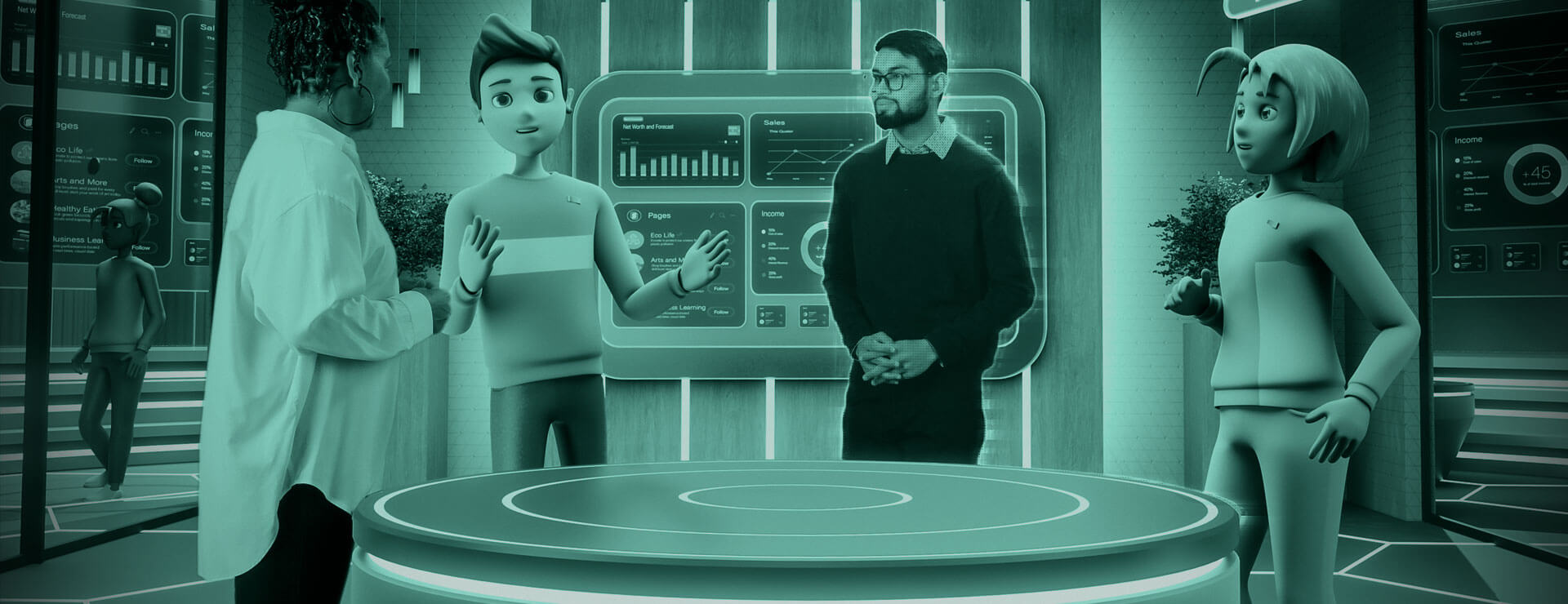
Project Immersive Democracy starts with kickoff symposium

Magdeburg/Berlin, 27. April 2023

On 27.04.2023, the digital kick-off symposium of the “Immersive Democracy Project” took place. More than 50 interested people from various fields registered for the event. The focus was on the discussion of positive and negative potentials of the Metaverse on society and democracy. Both technological and social aspects play an important role.

At the beginning of the event, Matthias Quent, Professor of Sociology at the University of Applied Sciences Magdeburg Stendal, presented the project “Immersive Democracy” and its research in the metaverse:

The Immersive Democracy Project addresses the challenges of further developing the digital transformation towards an immersive virtual space, the so-called Metaverse. The focus of the project is on democratic culture and the critical accompaniment of this transformation.

The project aims to develop new insights and evidence to accompany the emergence of the metaverse and to learn early on from mistakes and dark sides of Web 2.0 in order to make the Internet of the future more inclusive and democratic. This will be done through collaboration and exchange with civil society, academic, and industry stakeholders. A call for papers to promote especially early-stage research in the context of the Metaverse has been published on the recently launched project website. Interested parties can submit research proposals and ideas until the end of May, for which a budget is available. Various events will be offered as part of the project, where all interested parties are welcome to participate in discussions and share expertise. In addition, there are various sub-projects in different contexts, the results of which will be published on the website.

Marie von Stauffenberg and Laura Hirvi (Meta) presented their perspectives on the Metaverse and the importance of research conducted by the immersive democracy project and the European Metaverse Research Network.

A cooperation with Itas at KIT in Karlsruhe made the event possible, at which Octavia Madeira and Georg Plattner also spoke. They were the first in Germany to address the question of Metaverse, democratic culture and extremism in a scientific context already in May 2022.

Matthias Quent’s input highlighted conceptual categorizations of the particular aspects of immersive environments and the observation that individuals could benefit greatly from Metaverse technologies in terms of education and democratic skills, while the risks are mainly found at the structural level.

Companies, organizations, and countries are striving to shape and develop the Metaverse. A number of specific issues were discussed in the presentations and discussions: Immersive democracy, health, and radicalization are just some of the aspects that the Metaverse could impact.

Although the metaverse offers great potential for diversity and self-efficacy, risks such as data privacy and misuse (dark participation) must still be taken into account. The goal is to maximize the opportunities while minimizing the risks.

Mental health also plays an important role in the Metaverse, as virtual and augmented reality can be used to treat mental illness and addiction. However, there are also concerns about possible addiction to games and online activities.

Another important issue is the accessibility and availability of (VR) technology. Currently, VR poses a challenge for some people, especially those with physical limitations. It is important to pay attention to availability, affordability, and compatibility on different platforms when developing VR technology. Future scenarios for the Metaverse address security, freedom, and extremism, and emphasize the importance of engaging users and promoting democratic principles of inclusion and diversity. Thus, the Metaverse offers both challenges and opportunities for our society and its development.

We look forward to further discussions and research contributions from the Immersive Democracy project and hope to see you at future events!

In the shoes of others

Using virtual reality to change perspectives and promote empathy in order to better understand those affected by hate crime

10 a.m. – 5 p.m., August 22, University of the Hamburg Police Academy, Braamkamp 3B, 22297 Hamburg

In 2019, Greater Manchester Police (GMP) victim satisfaction surveys showed that just under half of victims of hate were not satisfied with the way police officers were handling their complaints and this needed to be addressed, so project “Affinity” was born. “Affinity”, a collaboration between Mother Mountain Productions CIC (MMP) and Greater Manchester Police, created a 360-3D virtual reality experience that allowed police officers to directly experience hate crime by putting officers literally “in the shoes” of victims, with the aim to increase connection and empathy.

MMP used VR technology to give the Police an immersive experience, so they were able to feel the effect of hate crime on those who experienced it, rather than to just understand it intellectually. An experience was created where officers literally ‘changed places’ with victims and saw the world from their point of view.

Made with the help of the communities affected, the films portrayed real life stories of people who had suffered antisemitism, transphobia and disability hate crime and the project, which concluded early in 2023, has had real impact. Recent data extracted from the responses of officers has given an indication of the power of the immersive experience. Not only have the officers felt that overall they have a better understanding of hate crime over 90%, but 93% stated that they now know what it “ feels” like to be a victim of hate crime. The result that has most impact however is that some 18 months on, 43% of officers have said that they have changed their behaviours when dealing with hate crime as a result of going through the VR experience. This shows the power and effect and lasting impact of immersive VR when related to real life events.

In this workshop, we want to discuss and explore the “Affinity” project together; the VR applications can be tested during the workshop sessions.

The workshop will be held in english.

Online participation is possible.

Organizers:

  • Prof. Dr. Eva Groß Hochschule Akademie der Polizei Hamburg / eva.gross at poladium.de
  • Prof. Dr. Matthias Quent Hochschule Magdeburg-Stendal / matthias.quent at h2.de
  • Prof Dr. Ulrike Zähringer Hochschule Akademie der Polizei Hamburg / ulrike.zaehringer at poladium.de

Save the date: Symposium Social VR & Gaming

June 15, 2023 | 10:00 – 12:00 MESZ | online

Presentation & discussion of two new studies by the Immersive Democracy Project.

Keynote 1: VR Gaming between Democracy Promotion and Right-Wing Extremism: Threats and Potentials for Digital Civil Society


Mick Prinz (Project Manager Good Gaming – Well Played Democracy)


Creating immersive worlds and enabling social interactions between users has long been an integral part of digital gaming worlds. The far right also uses the possibilities provided by video game spaces to network in various places in gaming, to build groups, and to disseminate inhumane content. Platforms such as Roblox, Minecraft, and GTA Online are particularly susceptible to far-right meta-politics. Development and design of virtual realities and the Metaverse must draw on these experiences and think along the threats, but also the opportunities from the gaming world.

Keynote 2: Worldbuilding in Social VR:Political implications of avatar and space design in VRChat, Rec Room and others.

Arne Vogelgesang (Association for the Study of Social Composition).


Given that many social VR platforms tend to rely heavily on usergenerated content, decisions about the possibilities and limits of influencing the “look and feel” of virtual social spaces are not just technical issues, but important factors in the formation of the political culture of such spaces: decisions about the possibilities of aesthetic participation are also decisions about governance. However, while user safety and protection from digitized violence are recognized as important aspects of shaping inclusive social spaces in VR, the role of their aesthetics in relation to this is less clear to assess. This talk exemplarily outlines the feature sets of some social VR platforms in terms of how they enable, encourage, and control aesthetic co-creation by users and speculates on the influences of different models of content production on the emergence of communities in social VR.

Citizen participation in the metaverse

Di. 16. Mai 2023 | 10:00 Uhr–11:30 Uhr MESZ | Online

What can democratic participation in the metaverse look like in concrete terms?

In 2021, Meta Platforms unveiled its vision of the Metaverse, sparking a debate about the future of the digital world. While some see the Metaverse as a promising new environment, others see it as a potential threat to our already polarized world or a place where people take refuge in alternative realities. Echoing the expectations and concerns raised about online social networks in the early 2010s, the question is who will ensure that the Metaverse, should it become “the next big thing,” is a democratic and deliberative space. What can democratic participation in the metaverse look like in very concrete terms? For example, how could cities and municipalities use immersive systems to allow citizens to participate?

Digital participation platforms enable citizens to participate in local decision-making processes, such as urban planning, asynchronously and from any location. At the same time, however, these platforms fail in picking up the broad population. On the one hand, this is due to general barriers to participation processes, and on the other hand to the usability of the digital tools. In different studies, advantages of the use of immersive systems for participatory urban planning could be worked out. This article will present results and discuss how cities and municipalities can use the metaverse to allow their citizens to participate in the further development of their immediate environment. Approaches of digital twins will be presented and at the same time it will be discussed how more inclusive immersive systems can be developed together with different actors in the sense of a democratization of technology development.

Event with, among others: Dr. Jonas Fegert (Head of Department Information Management and Analytics, Information Process Engineering (IPE), FZI Forschungszentrum Informatik) & Paulina Porten (Creative Technologist & Interaction Designer).

The event will be held in German language.

Democracy in the Metaverse: Opportunities and risks

Do. 27. April 2023 | 10:00 Uhr–13:00 Uhr MESZ | Onlineveranstaltung

Digital kick-off for a new field of research and action: Opportunities and risks of immersive technologies for democracy

The metaverse promises digital freedom and immersive experiences in a whole new form. However, it is unclear whether and how democratic structures and cultures can be implemented in the metaverse. We want to discuss this with you in a three-hour workshop on April 27, 2023. The symposium will take place on Zoom and is the kick-off for a series of events of the research project “Democratic Culture in Immersive Environments”. The events serve to present and discuss new studies and development as well as transdisciplinary networking.

With contributions by:

  • Dr. Georg Plattner (ITAS)
  • Dr. Laura Hrivi & Marie von Stauffenberg (Meta)
  • Prof. Dr. Matthias Quent (H2)
  • Dr. Octavia Madeira (ITAS)

The symposium is a collaborative event of the immersive democracy project at the Institute for Democratic Culture at Magdeburg-Stendal University of Applied Sciences (Prof. Dr. Matthias Quent) with the Institute for Technology Assessment and Systems Analysis (ITAS) at the Karlsruhe Institute of Technology (KIT) (Dr. Georg Plattner, Dr. Octavia Madeira) in the framework of the European Metaverse Research Network.

Chatham House Rules apply.

The event will be held in German language.

Registration: The number of participants is limited. Please register for the event on the waiting list here by 04/13/2023. Confirmations with the participation link will be sent by 20.04.2023.

Stay tuned to the latest news:

Current publications and dates in the newsletter